✦
Explosive eruptions
Gas-rich magma can produce powerful ash columns and blasts.
The Cascade volcano whose 1980 collapse, lateral blast and ash column transformed the landscape — and changed volcanic hazard science worldwide.
Mount St. Helens is continuously monitored and conditions can change over time. View the Volcoholics volcano directory for the latest verified official position from USGS Cascades Volcano Observatory.
View latest Mount St. Helens status →Mount St. Helens is the most active volcano in the Cascade Range and one of the world's best-studied volcanic systems.
The 18 May 1980 eruption removed the upper 400 metres of the mountain, opened a vast horseshoe-shaped crater to the north and produced a debris avalanche, lateral blast, pyroclastic flows, ashfall and lahars.
The volcano did not stop there. Lava domes grew during 1980–1986 and again during 2004–2008, while Crater Glacier developed around them inside the new crater.

Mount St. Helens can alternate between long quiet intervals, earthquake swarms, magma intrusion, dome growth and explosive eruption. Its 1980 sector collapse reshaped both the mountain and modern volcanology.
Check the latest verified status →The 1980 catastrophe was not a simple vertical explosion. It began with structural failure and unfolded in minutes.
A shallow cryptodome pushes the north flank outward.
Shaking removes support from the unstable bulge.
The summit and north flank collapse in a vast debris avalanche.
Pressure escapes sideways in a devastating northward blast.
Ash and gas rise high after the magma system is exposed.
Meltwater and volcanic debris surge down river valleys.
Viscous dacite magma rises through a steep volcanic edifice and may accumulate as lava domes.


The landslide removed the summit and northern flank, leaving a crater unlike the volcano's pre-1980 cone.
Inside it, lava domes from two eruptive periods occupy only a fraction of the missing volume, while one of North America's youngest glaciers has grown around them.
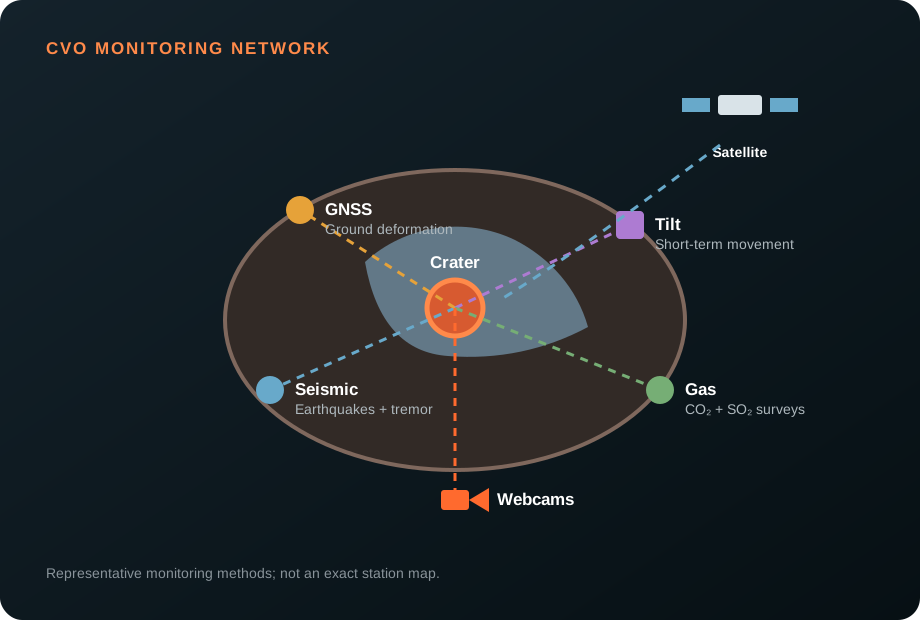
CVO watches earthquakes, deformation, gas, heat, ice and surface change to distinguish normal background activity from renewed unrest.
Multiple eruptive stages build the complex volcano known today.
Large explosive eruptions and dome growth reshape the summit.
Explosions and lava extrusion mark the last activity before the twentieth century.
Unrest rapidly escalates, followed by steam explosions and growth of the north-flank bulge.
The summit and north flank collapse, triggering the defining eruption and killing 57 people.
Repeated extrusion partly rebuilds the crater floor.
Spine-like lava extrusion adds roughly the same volume as the 1980–86 dome-building period.
The volcano remains active, quiet and closely watched.
Gas-rich magma can produce powerful ash columns and blasts.
Hot ash, gas and rock can move rapidly across the ground.
Water, snow and volcanic debris can surge far down river valleys.
Ash can affect communities, agriculture, transport and aviation.
Reality: a huge landslide removed support and triggered the lateral blast.
Reality: it erupted again from 2004 to 2008 and remains active.
Reality: future activity could range from dome growth to smaller or differently directed explosions.
Reality: it contains two lava domes, a glacier and an active hydrothermal system.
The eruption removed the summit and north flank, lowered the mountain by roughly 400 metres and opened the horseshoe crater seen today.

No. It is currently at official monitoring, with background activity.
The latest eruptive period lasted from 2004 to 2008 and built a new lava dome.
Collapse of the unstable north flank suddenly removed pressure from shallow magma, releasing a powerful horizontal blast.
The 1980 debris avalanche removed the summit and northern side of the volcano.
Yes. It remains an active volcano, although there are currently no signs of an imminent eruption.
Operational status belongs to the USGS Cascades Volcano Observatory. Volcoholics provides context and never replaces official warnings.